WhatsApp for Restaurants: Why a Conversational Agent Is a Game-Changer in 2026
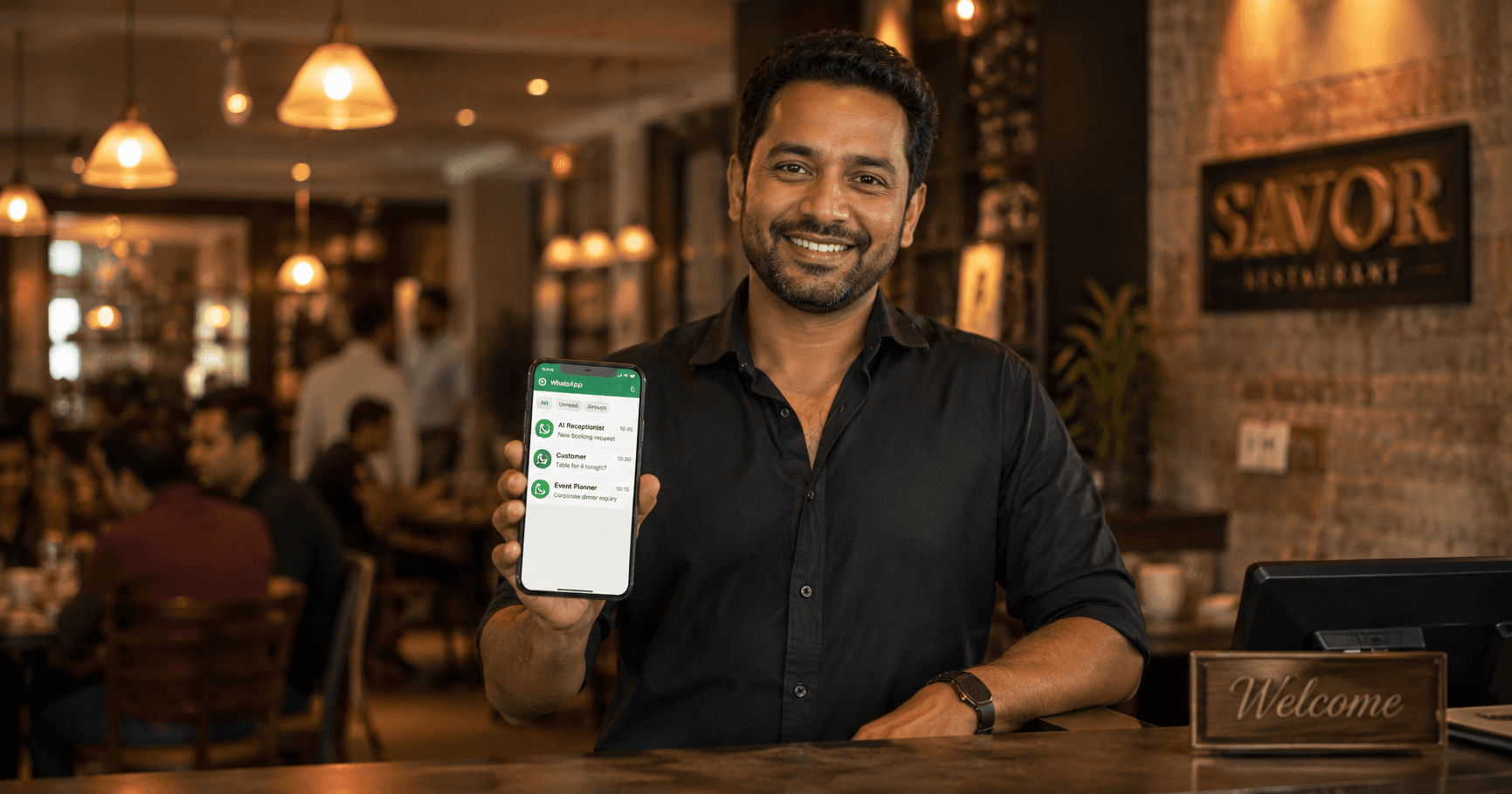
It's 7:30 PM on a Friday. Your restaurant is fully booked, service is in full swing, and your phone won't stop buzzing. Not calls this time — WhatsApp messages. "Do you have a table for 4 at 9 PM?" "Can I order takeaway?" "Do you have gluten-free options?"
In 2026, 72% of consumers prefer sending a message over making a phone call. And if you don't respond within 5 minutes, they move on to the next restaurant.
WhatsApp: The Channel Your Customers Already Use
The numbers speak for themselves:
- 2 billion people use WhatsApp daily worldwide
- 90% of messages are read within 3 minutes of receipt
- 53% of customers prefer booking by message rather than phone
- The average response time of a restaurant on WhatsApp without automation: 45 minutes
Meanwhile, your competitors who respond in under 2 minutes are capturing those customers. Speed of response is no longer a bonus — it's a selection criterion.
The Problem: Manual Responses Are Impossible
A typical restaurant receives 30 to 80 WhatsApp messages per day. The vast majority concern:
| Type of request | Share of volume | Complexity |
|---|---|---|
| Reservations | 40% | Low — date, time, party size |
| Menu and allergens | 25% | Low — fixed information |
| Takeaway orders | 20% | Medium — multiple choices |
| Hours and location | 10% | None — static info |
| Special requests | 5% | High — requires a human |
95% of requests are repetitive and predictable. Yet most restaurant owners spend 1 to 2 hours per day answering them manually — time stolen from service, cooking, and management.
The WhatsApp Agent: Your Best Virtual Employee
A WhatsApp conversational agent for restaurants is an assistant that:
Responds instantly, 24/7:
- Takes reservations and integrates them into your booking system
- Sends the complete menu with up-to-date prices
- Manages takeaway orders from start to finish
- Informs about allergens, vegetarian options, and set menus
- Automatically sends a confirmation and a reminder the day before
Adapts to your restaurant:
- Knows your daily specials, signature dishes, and opening hours
- Handles reservation modifications and cancellations
- Transfers to you only for complex requests (private events, custom menus)
- Speaks multiple languages for international customers
Real-World Example: Pizzeria Da Marco (Lyon)
Fictitious example to illustrate the impact
Before the WhatsApp agent:
- 50 WhatsApp messages/day, average response time: 1h20
- 30% of reservation requests lost (no timely response)
- Owner responds between services, often with availability errors
- Takeaway orders taken incorrectly — 2 to 3 errors per week
After activating Allolina on WhatsApp:
- Average response time: 8 seconds
- Reservation request conversion rate: 92%
- Takeaway orders up 35% (customers order at midnight for the next day)
- 0 order-taking errors in 3 months
- +€4,200 in monthly revenue
Marco says: "My customers love it. They send a message at 11 PM to book lunch the next day, and they get an instant confirmation. Before, those reservations simply didn't exist."
5 Mistakes to Avoid with a Restaurant WhatsApp Agent
1. Choosing a solution that doesn't know your industry
A generic chatbot doesn't know that a "cover" is a reservation, not a lid. Choose a solution built for restaurants.
2. Neglecting personalization
Your agent should reflect your restaurant's identity — tone, phrases, menu knowledge. Generic messages drive away regulars.
3. Not integrating with your reservation system
If the agent takes a reservation but you have to manually enter it in your book, you've saved response time but not administrative burden.
4. Forgetting human handoff
For complex requests (rare allergy, private event, complaint), the agent must be able to hand over properly, with the conversation context.
5. Ignoring the analytics
A good agent shows you what your customers ask most, when they contact you, and what you're missing. This data is gold for your business.
WhatsApp Business API vs. Conversational Agent: What's the Difference?
WhatsApp Business (the free app) lets you:
- Create a professional profile
- Send pre-written quick replies
- Organize conversations with labels
A conversational agent like Allolina goes much further:
- Understands natural language messages (no exact keywords needed)
- Manages complete conversations end-to-end
- Adapts to context (a customer who says "same as last time" gets their previous order)
- Makes decisions (checks availability, suggests alternatives when full)
WhatsApp Business is a tool. A conversational agent is a virtual employee.
Ready to Turn Your WhatsApp Messages into Reservations?
Calculate your potential:
- How many WhatsApp messages do you receive per day? _________
- How many go unanswered or get a late response? _________
- Among those, how many are reservations or orders? _________
- Your monthly loss = (lost messages x €40 average order x 30 days)
If the result exceeds €300/month, Allolina pays for itself in the first week.